
Introduction
Among Africa’s legendary Big Five, few animals command as much respect as the Cape buffalo. Known as Black Death, this powerful, dangerous game animal has earned its reputation not because it is the largest or fastest animal in Africa, but because a wounded buffalo can be remarkably resilient, unpredictable, and willing to turn the hunt into a close-range fight. If you’re considering cape buffalo hunting in South Africa, understanding the animal and the hunt is essential before stepping into the bush.
This guide covers what makes Cape buffalo one of the continent’s most challenging dangerous game species, how hunters pursue mature bulls, where shot placement matters most, and what to expect during a safari with Global Hunting Solutions. Whether you’re planning your first cape buffalo hunt or returning to Africa for another dangerous game hunting safari, good preparation helps make the experience disciplined, informed, and rewarding.
Founded by Travis Wier and backed by over 30 years of global hunting experience, Global Hunting Solutions and 4 Aces Safari Outfitters bring owner-led planning, direct access to professional hunters (PHs), and luxury service from arrival to departure for hunters ready to pursue Black Death in South Africa.
What Makes Cape Buffalo “Black Death” and Africa’s Most Dangerous Game
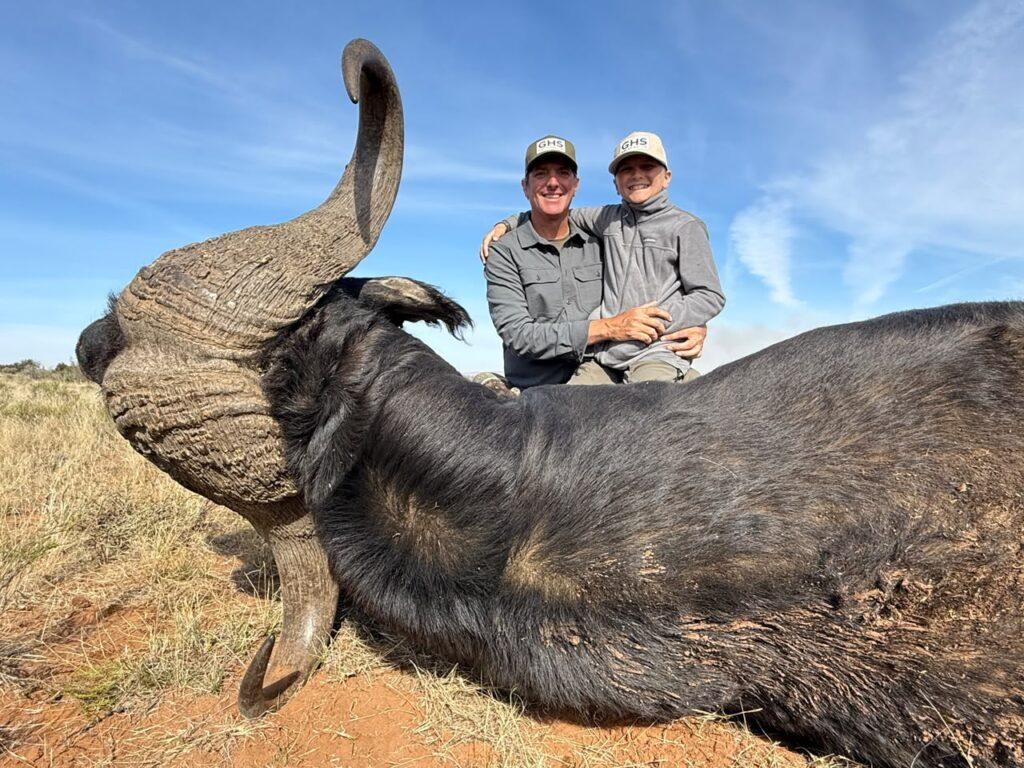
Cape buffalo have long been regarded as one of Africa’s toughest dangerous game animals. Their reputation comes from a combination of immense strength, exceptional endurance, and the determination to defend themselves when threatened. Unlike many other species that instinctively flee, a wounded buffalo may stop, seek cover, circle back, and face whatever is following it.
A mature bull can weigh up to 2,000 pounds, carrying that weight on a heavily muscled frame protected by a thick hide. Across its forehead sits the horn boss, a solid shield of fused horn that develops with age and helps protect the animal during battles with rival bulls. Combined with impressive stamina, these physical characteristics make the Cape buffalo exceptionally difficult to anchor without accurate shot placement.
Although Cape buffalo live in herds for much of their lives, hunters rarely pursue the breeding group. Mature bulls eventually leave the herd, becoming solitary animals or forming small bachelor groups. These older bulls are generally the preferred target because they have already contributed to the breeding population and represent the most ethical and responsible target animals for a dangerous game hunt.
What truly separates the Cape buffalo from many other dangerous game species is its behavior after being wounded. Rather than continuing to run, an injured buffalo may retreat into dense vegetation, using thick cover to conceal its position or turn on the follow-up. This is why careful follow-up procedures are such an important part of every cape buffalo hunt.
Once the shot is fired, the professional hunter (PH), trackers, and hunters work together to evaluate the situation before moving forward. Fresh spoor, blood sign, broken vegetation, and wind direction all influence the next decision. Rushing into a heavy bush after a wounded buffalo is never the safest option.
Equipment also plays an important role in ethical hunting. South African regulations require a minimum caliber of .375 H&H Magnum for Cape buffalo, and it remains the benchmark cartridge for dangerous game. It delivers the penetration needed to reach the buffalo’s vital organs while offering recoil that many experienced hunters can manage confidently. Hunters should still confirm current firearm and caliber requirements with Global Hunting Solutions, the outfitter, and relevant authorities before booking.
For many hunters, dangerous game hunting in Africa represents the ultimate hunting challenge because success depends on much more than pulling the trigger. Reading the terrain, trusting your hunting team, exercising patience, and making one well-placed shot all contribute to a successful safari.
Why Professional Guidance Matters on a Cape Buffalo Hunt
Cape buffalo hunting is a team effort. Your licensed professional hunter (PH) makes decisions about the stalk, identifies the right bull, judges when conditions are suitable for a shot, knows when to hold, and manages every follow-up if needed. Experienced trackers also play a vital role by interpreting fresh tracks, dung, broken vegetation, blood signs, wind direction, and subtle signs that most hunters would never notice.
Working together allows the hunt to progress carefully and methodically. Every decision is made with hunter safety, a clean, ethical harvest, and respect for the animal in mind.
Understanding the Dagga Boy: The Buffalo You Actually Hunt
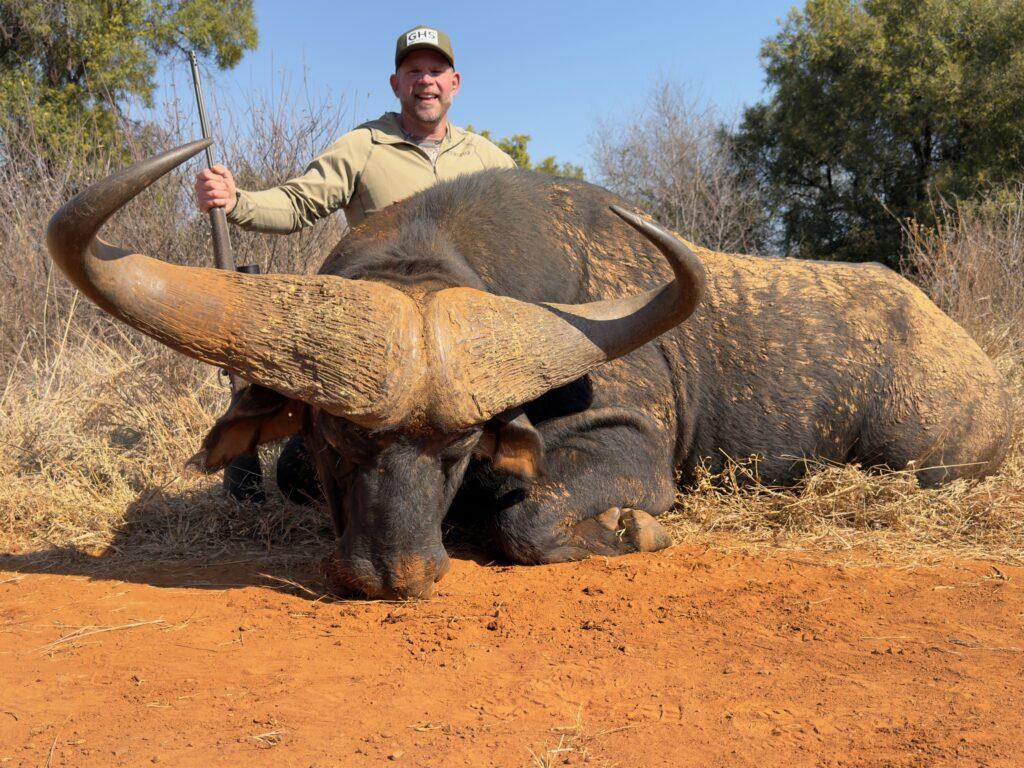
When hunters imagine Cape buffalo, they often picture large herds spread across open grasslands. In reality, the buffalo most hunters pursue on a cape buffalo hunt is usually a Dagga Boy, an older bull that has left the breeding herd and now spends its days alone or in a small bachelor group.
The name “Dagga Boy” comes from the Afrikaans word dagga, referring to the mud these mature bulls frequently wallow in. After cooling off in muddy pools, the dried mud coats their bodies, helping protect them from insects and the heat while giving them a darker appearance.
Years of fighting and surviving in the bush leave their mark on these old bulls. Their horn bosses become fully hardened, horn tips often show wear, and scars across the face and shoulders tell the story of countless battles. These are the characteristics experienced hunters and professional hunters (PHs) look for when judging a mature buffalo bull.
Dagga Boys are commonly found in thick bushveld close to dependable water sources. During the warmer parts of the day, they often rest in heavy cover before moving to drink or feed when temperatures become more comfortable. Understanding these daily patterns helps the hunting team decide where to begin tracking each morning.
Finding the right bull requires careful observation rather than covering ground as quickly as possible. Trackers study fresh spoor, examine dung for freshness, and look for broken branches, feeding signs, and disturbed soil. Each clue helps narrow the search until the team is confident they are following a mature animal.
Age is one of the most important factors in trophy quality. While horn spread attracts attention, experienced PHs place equal importance on boss development, body condition, facial features, and overall maturity. A weathered Dagga Boy with a heavy boss and years of character often represents a more responsible and rewarding bull to take than a younger bull with wider horns.
Understanding how these mature bulls behave also explains why the hunt unfolds the way it does. Rather than driving from one location to another, hoping for a chance encounter, hunters spend their time tracking a specific animal and waiting for the right opportunity. That patient, track-first approach is what makes Cape buffalo hunting so different from a drive-by plains game encounter. You earn the opportunity on foot, one sign at a time.
How Cape Buffalo Are Hunted in South Africa
Cape buffalo hunting in South Africa is built around one of Africa’s classic dangerous game methods: walk-and-stalk hunting on foot. Rather than waiting over bait or sitting in a blind, hunters follow fresh tracks on foot, relying on experienced trackers and a licensed professional hunter (PH) to locate a mature bull. Every hunt is different, and no two stalks unfold the same way.
Most hunting days begin before sunrise, when cooler temperatures and softer ground make fresh spoor easier to read. The team heads into the hunting area looking for signs of overnight buffalo movement, including tracks, fresh dung, feeding areas, and waterholes that mature bulls regularly visit.
Once fresh spoor is found, the pace changes. What may begin as a steady walk can quickly become a slow, deliberate stalk through thick bushveld. Trackers constantly assess the age and direction of the tracks while the PH monitors the wind and terrain to determine the safest approach.
Patience is one of the most valuable skills on a Cape buffalo hunt. A mature bull may travel several miles before settling into heavy cover, and rushing the stalk often creates more problems than it solves. Sometimes the team must pause for several minutes or change direction completely if the wind shifts or visibility becomes too limited.
Most encounters happen at close range, typically between 20 and 40 yards. In thick bush, hunters often hear movement before they see the buffalo. At these distances, there is little time to react, making clear communication between the hunter and PH especially important.
The professional hunter manages every stage of the final approach. The PH identifies the correct bull, judges whether the shooting angle is safe, and decides whether to take the shot or wait for a better opportunity. Passing on a marginal shot is often the right decision, especially when hunting dangerous game.
Because Cape buffalo are highly aware of their surroundings, the final stalk demands complete concentration. Moving quietly, staying downwind, and trusting the hunting team are just as important as accurate shooting. For many hunters, these tense moments are what make a Cape buffalo safari one of Africa’s most memorable dangerous game hunts.
Cape Buffalo Shot Placement
Accurate shot placement is the foundation of an ethical Cape buffalo hunt. Even with a powerful rifle, poor bullet placement can result in a wounded animal and a potentially dangerous follow-up. Understanding where to aim before the hunt begins gives hunters the strongest chance of a clean, ethical harvest.
The preferred shot is a broadside presentation. Aim along the front leg and approximately one-third of the way up the body to reach the heart and lower lungs. This angle provides excellent access to the vital organs while maximizing penetration through the buffalo’s heavy muscle and rib cage.
A frontal shot may also be effective when the buffalo is standing squarely, and the professional hunter (PH) recommends taking it. The point of aim is centered on the chest at shoulder level, so the bullet travels directly into the vital organs. Because this opportunity requires precision, it should only be taken under the guidance of your PH.
For a quartering-away shot, the aiming point shifts slightly to account for the angle of the animal. The goal remains the same: direct the bullet through the heart and lungs while avoiding unnecessary impact with the heavy shoulder bone.
Many first-time hunters are tempted to aim for the head because it appears to be a large target. In reality, head and neck shots are generally discouraged. The buffalo’s massive horn boss and dense skull can prevent proper bullet penetration if the shot is even slightly misplaced.
After firing, stay on the rifle and be prepared for a follow-up shot if your PH calls for it. A Cape buffalo can cover ground surprisingly quickly, and maintaining visual contact allows the PH to assess the situation immediately.
If the buffalo disappears into thick cover, the team slows down and carefully evaluates the next steps. No hunter should approach a downed buffalo until the PH has confirmed it is safe to do so. That disciplined approach is one of the reasons experienced hunting teams handle dangerous game safely.
Rifle and Caliber Selection for Cape Buffalo Hunting
The right rifle for Cape buffalo hunting should give you confidence when the opportunity presents itself. While caliber matters, familiarity with your firearm and consistent shot placement matter even more. A rifle you shoot accurately is always preferable to a larger caliber you struggle to control.
South African law requires a .375-caliber minimum for Cape buffalo hunting, and the .375 H&H Magnum remains the standard recommendation for many professional hunters (PHs). It offers the penetration needed for dangerous game while remaining manageable for most experienced shooters. Hunters should confirm current firearm and caliber requirements with Global Hunting Solutions, the outfitter, and relevant authorities before booking.
Hunters who are comfortable with heavier recoil may choose cartridges such as the .416 Rigby or .458 Lott. These larger calibers deliver additional penetration and authority, but they are most effective when paired with proper shooting technique and regular practice.
Bullet choice is just as important as caliber. For the first shot, most PHs recommend a premium controlled-expansion soft-point bullet designed to penetrate deeply while expanding through the vital organs. If a follow-up shot becomes necessary, many switch to non-expanding solid bullets for maximum penetration through heavy bone and muscle.
Before traveling to South Africa, spend time practicing with the same rifle and ammunition you plan to use on safari. Shooting from standing positions and off traditional shooting sticks closely reflects field conditions and helps build confidence before the hunt.
Quality equipment supports good decision-making, but it cannot replace preparation. Once your rifle is selected and you’re comfortable using it, your focus shifts to field discipline: listening to your PH, staying ready on the rifle, and making one clean shot when the opportunity is right.
What to Expect on a Cape Buffalo Hunt with Global Hunting Solutions
A Cape buffalo safari is about much more than the moment you take the shot. It’s a multi-day experience that combines careful planning, skilled tracking, and teamwork in South African buffalo habitat. Every day presents different conditions, which is why flexibility and patience are such important parts of the hunt.
Most Cape buffalo hunts are scheduled over several days to allow enough time to locate a mature bull and wait for the right opportunity. Rather than rushing the hunt, the hunting team focuses on finding an old Dagga Boy that meets both ethical and trophy-quality standards.
Your day typically starts before sunrise with breakfast and a briefing before heading into the hunting area. The cooler morning hours provide the best opportunity to locate fresh spoor before the heat of the day makes tracking more challenging.
Once buffalo tracks are found, the day’s pace is dictated by the animals rather than the hunters. You may spend hours following spoor through bushveld, stopping regularly while trackers interpret subtle signs such as fresh dung, disturbed vegetation, or recent mud wallows. Some stalks end quickly, while others require persistence before the right bull is located.
Cape buffalo hunting is physically demanding. Expect to walk across uneven ground, move quietly through dense vegetation, and remain alert during long periods of tracking. While the pace is steady rather than extreme, a reasonable level of fitness helps you stay comfortable and focused when the opportunity finally arrives.
When the team reaches shooting distance, the professional hunter (PH) identifies the correct bull and confirms a safe shot angle. If the buffalo moves into heavy cover or doesn’t present a clean shot, you’ll wait. That discipline is part of the ethical dangerous game hunting in Africa and often leads to better outcomes than forcing a difficult opportunity.
Following a successful harvest, the team photographs the animal before beginning field dressing and trophy preparation. Your PH will also explain the next steps for trophy handling, documentation, and any export-related process based on current requirements, where applicable.
Season timing, permit requirements, quota availability, firearm rules, and export requirements can change, so hunters should confirm current details with Global Hunting Solutions, the outfitter, and relevant authorities before booking. Throughout the hunt, Global Hunting Solutions emphasizes careful planning, experienced guidance, and respect for both the hunter and the game. The goal is to provide a well-organized safari where every decision is made with safety and ethical hunting in mind.
Cape Buffalo Trophy Quality and Scoring
A memorable Cape buffalo trophy is measured by more than horn width. Mature bulls display years of survival through their physical features, and experienced professional hunters (PHs) look at the complete animal before recommending whether to take the shot.
One of the first characteristics they evaluate is the boss, the thick shield of fused horn across the forehead. A fully developed, hard boss is one of the clearest signs that a bull has reached maturity.
Horn spread is also important, but it should always be considered alongside age, body condition, and overall character. Older Dagga Boys often show worn horn tips, scarred hides, and heavier facial features that reflect years spent competing with other bulls and surviving in the bush.
Judging a trophy bull in the field takes experience. Your PH considers horn shape, boss development, body size, and behavior before deciding whether the animal meets the standards for a mature, ethical harvest. This careful evaluation helps ensure younger breeding bulls remain part of the population.
After the hunt, many hunters choose to have their trophy measured under recognized scoring systems. Rowland Ward primarily considers horn spread, while Safari Club International (SCI) uses a scoring method based on multiple horn measurements. Although these systems provide useful records, many hunters value the experience of tracking a mature Dagga Boy above the final score.
How to Book Your Cape Buffalo Hunt with Global Hunting Solutions
Planning your safari begins well before you arrive in South Africa. Choosing the right hunting area, preparing your equipment, and understanding what is included in your package all help create a smoother experience once you’re in the field.
Global Hunting Solutions and 4 Aces Safari Outfitters work with hunters to build safaris that match their experience, available time, and hunting goals. Whether you’re planning a dedicated Cape buffalo hunt or combining dangerous game with plains game species, the itinerary can be tailored to suit your trip.
A typical dangerous game package may include professional guiding services, experienced trackers, hunting vehicles, accommodations, meals, and support throughout the safari. Before traveling, you’ll also receive guidance on firearm documentation, recommended clothing, equipment, and other preparations to help you arrive ready to hunt. Hunters should confirm current firearm rules, permit requirements, package inclusions, and documentation needs with Global Hunting Solutions, the outfitter, and relevant authorities before booking.
Many hunters choose to combine Cape buffalo with species such as kudu, impala, wildebeest, or zebra while they’re already in South Africa. If that’s part of your plan, your itinerary can be arranged to make the most of your available hunting days.
For current packages, availability, and pricing, use the [South Africa Hunting page] or contact Global Hunting Solutions directly. Planning ahead provides more flexibility when selecting hunting dates and allows plenty of time to prepare for your safari. Book your cape buffalo hunt with [Global Hunting Solutions] to discuss availability and build a South Africa dangerous game hunting safari around your goals.
Ready to Hunt the “Black Death” in South Africa?
A successful Cape buffalo hunt begins long before you step into the bushveld. Understanding buffalo behavior, choosing the right equipment, and hunting alongside experienced professional hunters (PHs) all contribute to a safe, ethical, and rewarding dangerous game safari. Global Hunting Solutions and 4 Aces Safari Outfitters can help you plan a South Africa cape buffalo hunt that matches your experience, goals, schedule, and current availability.
Hunters comparing package options can use the [South Africa Hunting page] to review hunting opportunities in South Africa before booking. Book your cape buffalo hunt with [Global Hunting Solutions] to discuss availability and build a dangerous game hunting safari in Africa around your goals.
Frequently Asked Questions
Is a .375 H&H enough for hunting Cape buffalo?
Yes. The .375 H&H Magnum is the legal minimum caliber for Cape buffalo hunting in South Africa and remains the standard choice for many professional hunters (PHs). When paired with premium dangerous game ammunition and proper shot placement, it has the penetration needed for Cape buffalo.
Larger calibers such as the .416 Rigby and .458 Lott are also effective, but accurate shot placement is more important than using a bigger rifle that you cannot control under pressure. Hunters should confirm current firearm and caliber requirements with Global Hunting Solutions, the outfitter, and relevant authorities before booking.
How dangerous is Cape buffalo hunting?
Cape buffalo are widely regarded as one of Africa’s most dangerous game animals because a wounded bull may charge, circle back, or retreat into thick cover before confronting the follow-up team. Hunting with an experienced professional hunter (PH), maintaining shot discipline, and following proper safety procedures are essential throughout the safari.
What time of year is best for Cape buffalo hunting in South Africa?
The best time for Cape buffalo hunting in South Africa is often the cooler, drier months, when thinner vegetation, firmer ground, and more comfortable temperatures can make tracking easier. These conditions often improve visibility during walk-and-stalk hunts and help the hunting team read fresh spoor more effectively. Hunters should confirm current season dates, permit requirements, and availability with Global Hunting Solutions, the outfitter, and relevant authorities before booking.
How much does a Cape buffalo hunt in South Africa cost?
With Global Hunting Solutions, the 2027 Northern Cape (Kimberley) Cape buffalo trophy fee is $10,500 under 40 inches, $13,000 under 43 inches and $17,000 under 46 inches, plus daily rates from $550 per day. Two five-night packages include buffalo: Package 3 (buffalo and sable) at $16,590 and Package 9 (crocodile, buffalo and hyena) at $21,399. See our full 2027 price list. The cost of a Cape buffalo hunt in South Africa varies depending on the hunting area, safari length, accommodations, trophy fees, bull maturity, horn class, terrain, and whether the hunt is structured as a trophy bull, management bull, cow hunt, or combo safari with plains game.
Because dangerous game pricing can change based on availability, package structure, and current requirements, hunters should request current pricing directly. For current package pricing and availability, use the [South Africa Hunting page] or contact Global Hunting Solutions to discuss your hunting plans.
What is a Dagga Boy?
A Dagga Boy is an older Cape buffalo bull that has left the breeding herd to live alone or with a small bachelor group. The name comes from the mud these bulls wallow in, which dries on their hides and gives them a darker, weathered look. These mature bulls are the preferred target on a Cape buffalo hunt because they have fully developed bosses, worn horns, and have already contributed to the breeding population.
Can you hunt Cape buffalo in South Africa on a plains game safari?
Yes. Many hunters combine a Cape buffalo hunt with plains game species such as kudu, impala, wildebeest, or zebra during the same safari. Because Cape buffalo is dangerous game, it should be planned as the primary focus, with plains game added where time, area, and availability allow. Planning the itinerary in advance allows enough time to pursue both dangerous game and plains game while making the most of your trip to South Africa.